
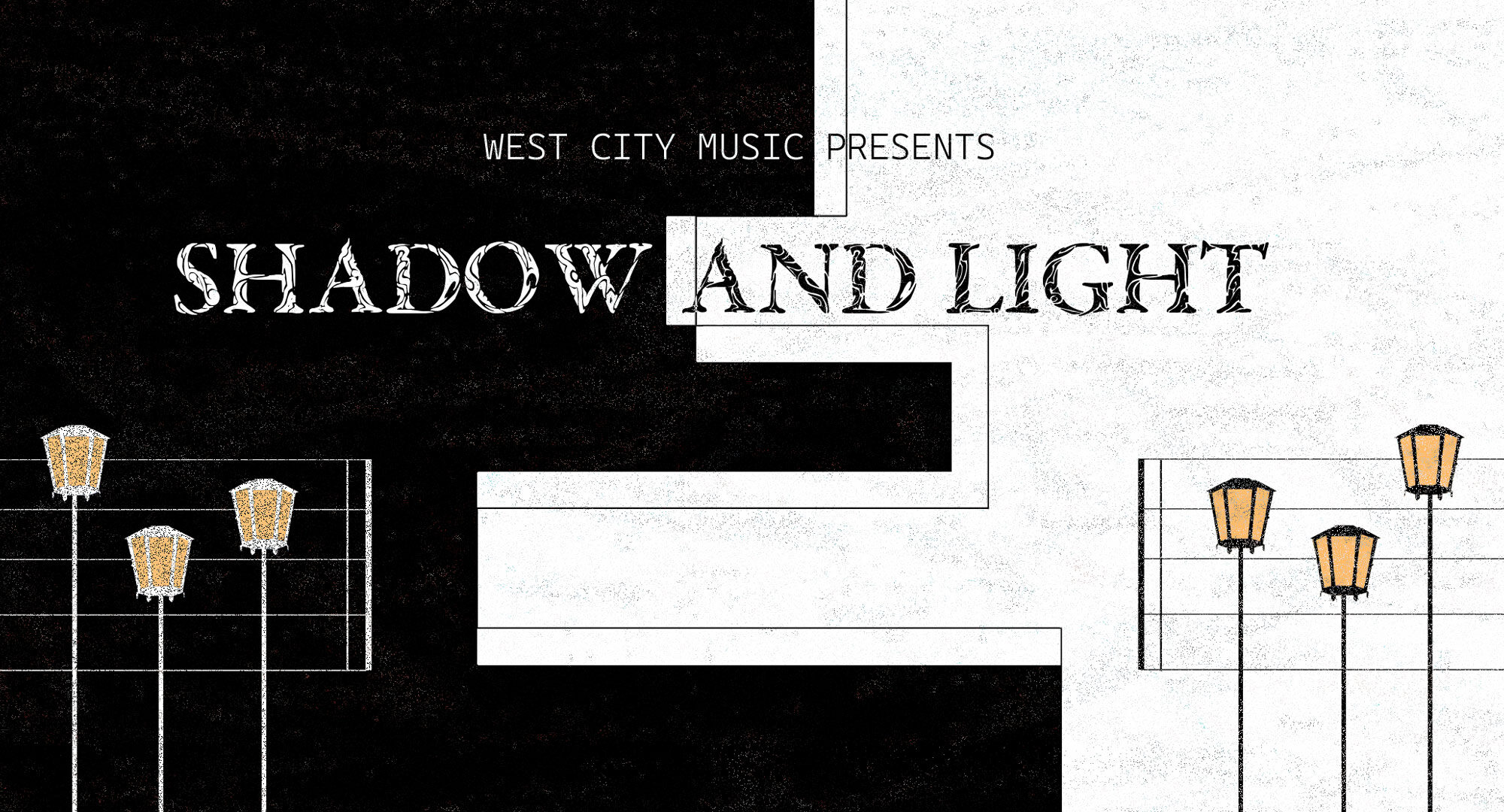
The West City Concert Band and the West City Youth Concert Band perform “Shadow and Light”, a joint concert at Avondale College Performing Arts Centre, Avondale.
12 July 2025
7:00 pm
Avondale College
Tickets can be purchased from:
https://www.eventbrite.co.nz/e/shadow-and-light-tickets-1409317449429
WEST CITY YOUTH CONCERT BAND
Galop — Dmitri Shostakovich
This lively and light-hearted piece is taken from Moscow, Cheryomushki, a satirical operetta by Russian composer Dmitri Shostakovich. Premiered in 1959, the operetta is set in a housing project in southwest Moscow and pokes fun at Soviet bureaucracy and the ongoing housing shortages of the time. The libretto was written by Russian humorists Vladimir Mass and Mikhail Chervinsky.
Despite its engaging music, Shostakovich himself was highly critical of the work. In a private letter to his friend Isaak Glikman, written just days before the premiere, he described the operetta as “boring, unimaginative, stupid.” While he distanced himself from the project, the music tells a different story. Galop stands out as a brief but exhilarating piece full of rhythmic energy and satirical flair.
Sheltering Sky — John Mackey
Sheltering Sky presents a moment of calm and reflection within the modern wind band repertoire. Unlike many of John Mackey’s other works that showcase dazzling virtuosity, this piece is lyrical and introspective. It draws on the style of traditional folk melodies, although the music is entirely original.
The opening features soft, layered harmonies that create a sense of stillness. Two main melodic ideas unfold gradually. The first is a descending line played by the oboe, followed by a rising trumpet phrase that answers it with quiet optimism. Mackey avoids conventional harmony, choosing instead extended chords and subtle dissonances that lend the music a dreamlike quality. The melodies overlap and dissolve into one another, creating a seamless flow. The piece eventually returns to the gentle material from the beginning, bringing the music to a peaceful close.
Shadow Rituals — Michael Markowski
Full of energy and rhythmic drive, Shadow Rituals challenges performers with its constant motion and dark intensity. The piece is described by the composer as a mystical dance, capturing something primal and ancient in its sound.
Markowski wrote this work for the Frank Ticheli Composition Contest and dedicated it to Ticheli, whose music had made a strong impression on him during his early years as a musician. The piece reflects that inspiration through its bold rhythms, sharp contrasts, and demanding performance style. It is a dramatic and engaging work that showcases both precision and passion.
Homage: Guardians of the Sea — Satoshi Yagisawa
Commissioned to celebrate the 60th anniversary of the Japanese Maritime Self Defence Force Band, this piece pays tribute to both the service and musical tradition of the organisation. Composer Satoshi Yagisawa includes a reference to Umi no Sakimori (Sentries of the Sea) by Kōsaku Yamada, one of Japan’s most influential composers.
Through sweeping themes and ceremonial gestures, Homage: Guardians of the Sea honours Yamada’s legacy and the commitment of those who serve at sea. The music captures both solemn respect and national pride, blending traditional influences with Yagisawa’s modern voice.
WEST CITY PERCUSSIONISTS
Little Sea Gongs – Gareth Farr
Little Sea Gongs is a miniature companion-piece to From the Depths Sound the Great Sea Gongs, a major work composed for the New Zealand Symphony Orchestra which incorporates the visual spectacle of three percussionists playing a line of ten roto-toms. The drumming style is very much inspired by Rarotongan log drumming and is fast, furious and very loud.
Little Sea Gongs started as a short drumming piece to end the composer’s stage show Drumdrag. Like the larger work, it was intended to be a Rarotongan-style composition, but played on western drums. It was never notated, and was intended to be flexible in its instrumentation—the drummers would simply play on whatever instruments they happened to have handy. The number of performers also varied from three to seven players.
INTERMISSION
WEST CITY CONCERT BAND
Overture in B flat — Caesar Giovannini (1966)
Caesar Giovannini (1925–2017) graduated from the Chicago Conservatory of Music in 1948 with a Bachelor of Music and a master’s degree in composition. During World War II he was appointed pianist for the US Navy Band in Washington, DC.
The band music composed by Giovannini became synonymous with spirited, energetic contemporary music, and the Overture in B flat was no exception. He was noted for his antiphonal use of winds responding to brass or percussion. This is most evident in the opening of the piece, where different sections of the band work in conversational unison. Giovannini develops the work melodically, harmonically, and rhythmically while showcasing the different colours within the concert band. He uses very tight, clean, almost mechanical writing to convey a sense of rhythmical stability. In stark contrast to this concept is the middle section of the work, which is led by a sonorous horn line, giving the theme a noble character. The piece ends as it began – interrupted by the opening brass fanfare and accompanied by the winds and percussion with their rhythmic energy and melodic intensity.
Bach’s Fugue à la Gigue — J.S. Bach (1705) arr. Gustav Holst (1928)
In December 1927, English composer Gustav Holst received a request from the BBC to compose a 12-to-15-minute work in one movement for its military band. The work fulfilling that request would be Hammersmith, Op. 52 (1930–31). But Holst, who had not written a note for military band since revising his own Second Suite in F for Military Band, Op. 28 in 1922, wanted to do a “warm-up” first. He wrote to D. Millar Craig, director of programs at BBC: “…If there is no immediate hurry, I would like to postpone writing this piece and first arrange one of Bach’s Organ Fugues for military band. I have had this at the back of my mind for many years.”
Holst went into greater detail in a rare interview given during his third visit to the United States in 1932: “When I was studying organ some forty years or more ago, it struck me that of all Bach’s organ works, just one, this fugue, seemed ineffective on the instrument for which it was composed… My publisher, rightfully fearing the opportunities for military band performance of the fugue would be small, insisted on issuing it in an orchestral arrangement, where of course it is likely to have many more performances. I still feel, however, that the band version is far richer and more effective!
The organ fugue to which Holst referred is the Fugue in G Major [BWV 577] from “Preludes, Fugues, Fantasias and Other Pieces” in Book III of the Organ Works: Bachgesellschaft. Holst himself gave the title Bach’s Fugue à la Gigue to the work, for its dance (or jig)-like compound time. For his work, Holst was paid 25 British pounds (a far greater sum in 1928 than today!).
Songs for Wind Ensemble — Yo Goto (2009)
Yo Goto is recognized as one of the leading composers and educators in the field of wind and percussion music in the United States and Japan.
Songs for Wind Ensemble is a lyrical work in which he provides an opportunity for individual performers to explore their own expression through the provided compositional framework. Songs was commissioned by the Hamamatsu Cultural Foundation that commissions new works for wind ensemble from Japanese composers. This like a number of his other compositions explores the concept of “musical simultaneity” in order to liberate audiences from the restrictions of linear time. Featuring numerous soloists, they are instructed to play simple songs and song fragments at their own tempo. Although each song in the piece is different, they are all derived from a single melody performed by the clarinet at the beginning of the piece. While listening to the piece, youcan imagine the peaceful tranquility of the natural landscapes and gardens of Japan… contrasted with the bustling and vibrant city life.
Urban Light — James M. David (2021)
Urban Light is a brilliant display of colours, forward momentum, and intertwining rhythmic layers that is inspired by the iconic Los Angeles landmark of the same name. Created by conceptual art pioneer Chris Burden in 2008, the original work is an assemblage of historic streetlamps that were transplanted from various cities in California and also Portland, Oregon. The tight spacing and repetitive forms interact with the famously dynamic LA sunlight transitioning to the exciting nighttime glow of the city. Primary melodic and rhythmic motives are derived from Morse code for the word “California,” creating an asymmetrical and syncopated groove that continuously builds in energy. Parallel “barre” chords reveal a classic rock/metal influence that reaches its zenith with a heavy percussion backbeat. Polyrhythmic layers and prismatic colours move over, around, and under each other, leading towards a thrilling and intense finale. James David dedicated Urban Light to his wife, who “introduced me to the West Coast’s beauty and spirit”.