
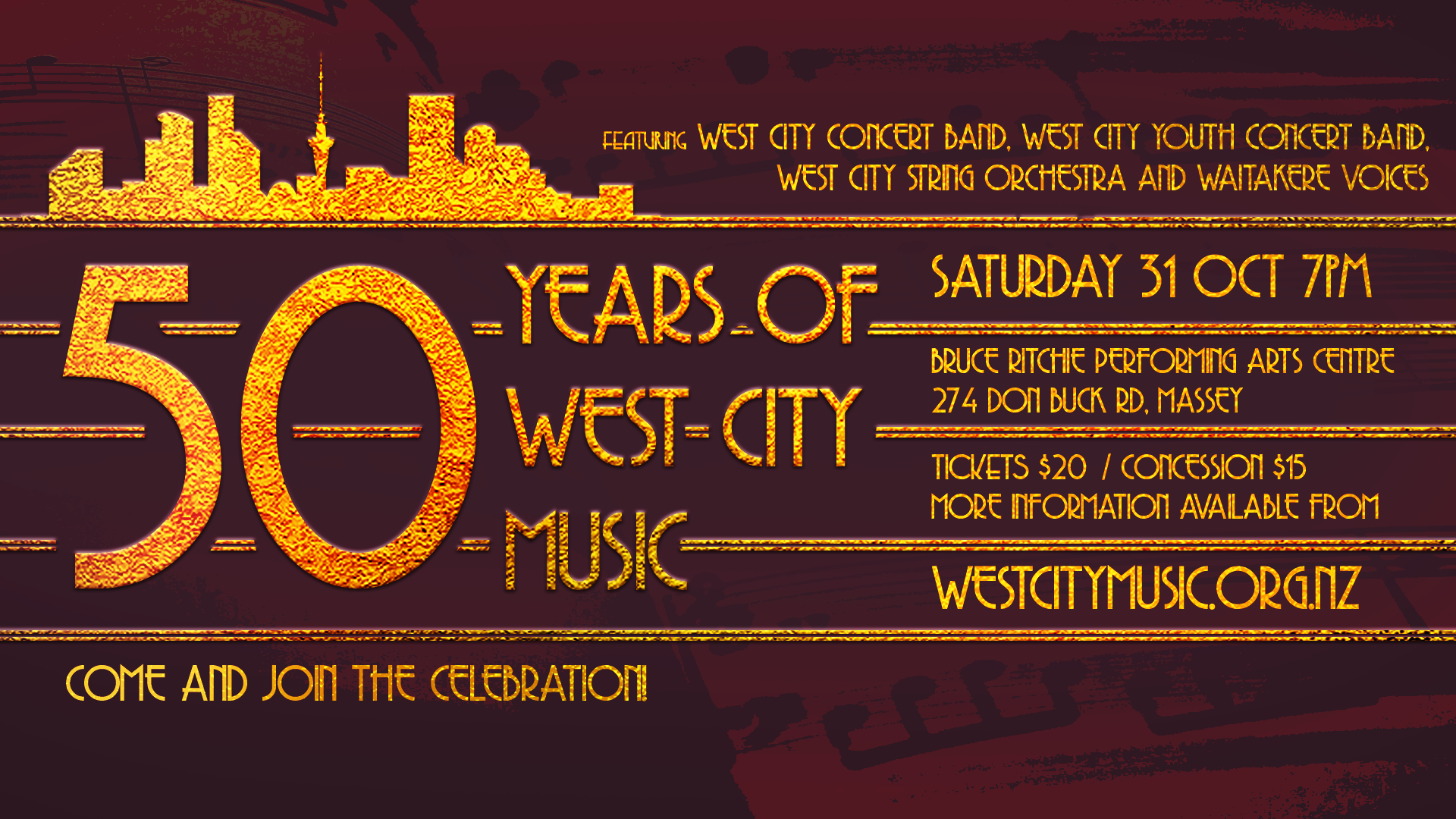
Saturday 31st October
Bruce Ritchie Performing Arts Centre, Massey High School
7pm
Featuring:
- West City Concert Band
- West City Youth Concert Band
- West City String Orchestra
- Waitakere Voices
West City Music is celebrating 50 years of community musicmaking with a joyous evening, sharing favourites old and new. From early beginnings as a brass and woodwind ensemble, to today’s choir, string orchestra, youth programmes and concert bands, West City Music will delight you in this evening of celebration.
Ave Verum Corpus – Wolfgang Amadeus Mozart
Composed in 1791, just six months before Mozart’s death, Ave Verum Corpus is one of his most beautiful and intimate sacred works. Originally written for four-part choir, strings and organ, this short motet sets a 14th-century Latin Eucharistic hymn reflecting on the suffering and sacrifice of Christ.
Despite its simplicity, the work demonstrates Mozart’s extraordinary ability to convey profound emotion through music. Its gentle harmonies, flowing melodic lines and restrained expression create a sense of peace and reverence.
Written during the final year of Mozart’s life, Ave Verum Corpus remains one of the most cherished works in the sacred choral repertoire.
God Only Knows – Brian Wilson and Tony Asher | The Beach Boys
Released in 1966 as part of The Beach Boys’ landmark album Pet Sounds, God Only Knows is widely regarded as one of the finest pop songs ever written.
Composed by Brian Wilson with lyrics by Tony Asher, the song was groundbreaking for its time, featuring sophisticated harmonies, unconventional chord progressions and an intricate arrangement that blended elements of classical music with contemporary pop.
The song’s opening line, “I may not always love you”, was particularly unusual for a love song, introducing a sense of vulnerability and uncertainty before developing into a heartfelt expression of devotion.
Nearly six decades later, God Only Knows continues to resonate with audiences around the world, demonstrating the enduring power of a beautifully crafted melody and sincere lyrics.
Kad ja pođoh na Bembašu – Traditional Bosnian Folk Song
Kad ja pođoh na Bembašu, meaning “When I Went to Bembaša”, is one of the most beloved traditional songs of Bosnia and Herzegovina, particularly associated with the city of Sarajevo.
The song belongs to the tradition of sevdalinka, a distinctive form of Bosnian folk music characterised by expressive melodies, poetic lyrics and themes of love, longing and nostalgia.
Bembaša, a historic location along the Miljacka River in Sarajevo, provides the setting for this gentle and evocative song. Its lyrics tell of a young person’s encounter with love, capturing the beauty and emotional depth of everyday life.
Over generations, Kad ja pođoh na Bembašu has become an important part of Sarajevo’s cultural identity. Its haunting melody and timeless sentiment continue to connect audiences with the rich musical heritage of the Balkans.
Finlandia (A Song of Peace) – Jean Sibelius
Composed in 1899, Finlandia is one of the most celebrated works by Finnish composer Jean Sibelius. Originally written as part of a series of musical tableaux, the work became a powerful symbol of Finnish national identity during a period of increasing Russian control.
Although much of the original orchestral work is dramatic and turbulent, its central hymn-like melody offers a striking contrast, expressing hope, dignity and a longing for peace.
This melody later became known as the Finlandia Hymn and has been adapted for numerous choral settings, including A Song of Peace, with words written by American poet Lloyd Stone in 1934.
Rather than celebrating one nation above another, Stone’s text expresses a universal message of understanding and compassion, recognising that people across the world share the same hopes for peace and freedom.
More than a century after its composition, Sibelius’s music continues to inspire audiences with its powerful message of unity, hope and peace.
Concerto for Strings in D Major RV121 – Antonio Vivaldi (1678-1741).
Born in Venice, Italy, Vivaldi was a virtuoso violinist and one of the greatest Baroque composers of the 18th Century. He was ordained as a priest in the Roman Catholic church at 25 years old. He was known as the “Red Priest”, not just because of his red hair but apparently for his fiery temperament. Fits of coughing due to his asthma forced him to give up celebrating Mass. He was then appointed the violin tutor at the Ospedale della Pietà, one of four foundations in Venice that cared for orphaned or abandoned children. In Vivaldi’s time, it was home to nearly 1,000 children. The boys lived separately, were taught a trade and had to leave at fifteen. The girls were taught music, and the most gifted of them were placed in a special class, “figlie di coro” (daughters of the choir). Many of them became well-known soloists and composers under their own names. Wealthy visitors came to Venice from all over Europe, especially to hear them perform at the chapel, hidden away in a high gallery behind a metal grill. Vivaldi composed 100s of concertos, cantatas and sacred music for them. The concertos were for varied solo instruments but also for string ensembles, such as this Concerto in D Major.
Allegro Molto: A dramatic opening theme of repeated notes is played in unison by the whole orchestra. Vivaldi enjoyed using “suspensions”, where one note of a chord is held over while other notes in the chord change, creating a “dissonance”. Thus, deliberately making the music sound “out of tune”.
Adagio: A short “bridging” movement to link the two Allegro movements. It is made up of four spacious chordal sequences with many “dissonances”.
Allegro: The 1st and 2nd violins, playing in unison, are kept busy with repeated semi-quaver notes, downward scales and quick leaps from one string to another. Violas, cellos and basses play together for what is called a “walking bass” where they wander through many different keys to accompany the violins.
Overture to the opera “La Cenerentola” (Cinderella)” – Gioachino Rossini (1792-1868):
Rossini was the most significant Italian composer of the first half of the 19th century. He is most famous for his 39 operas, especially his comic operas. Cinderella is an adaptation of the classic fairy tale, with certain key differences. There is no fairy godmother, but a philosopher who is the tutor to the handsome prince. There is no wicked stepmother but a pompous, cruel stepfather. There is no glass slipper but a matching silver bracelet to identify her. Her stepsisters are not turned into toads, or have their eyes pecked out, but Cinderella forgives them for their cruelty towards her. They all go to live with her prince at the royal palace. This is in keeping with the opera’s subtitle “Ossia La bontà in Triunfo” (Goodness triumphant).
Rossini had a standard format for his opera overtures. A dramatic slow introduction moves in fits and starts. A light Allegro Vivace follows (asking the violins for ricochet bowing) with wind solos and a perky piccolo. In the repeat, a “Rossini Crescendo” occurs. This is a short phrase repeated over and over, growing louder and more energetic each time until it reaches a massive climax.
The West City String Orchestra will be joined by members of the West City Concert Band for the wind solos.
Fantasia on Greensleeves
Ralph Vaughan Williams | Arranged by Robert W. Smith
A traditional melody dating from Tudor England, Greensleeves is put to masterful use in Vaughan Williams’ evocative fantasia. The composer once remarked, “The art of music above all arts is the expression of the soul of the nation.” In this delightful work, he captures something of the very essence of England through its folk music.
Tonight’s arrangement by Robert W. Smith also recalls a chapter in our own history. The West City Youth Concert Band performed it at the 2017 NZCBA Festival in Whangārei, conducted by Mat Stenbo.
La fille aux cheveux de lin (The Girl with the Flaxen Hair)
Claude Debussy | Arranged by John Moss
Soloist: Henry Valete
Originally written for solo piano, Debussy’s La fille aux cheveux de lin takes its title from a poem by Leconte de Lisle. Known for its gentle lyricism and musical simplicity, the piece offers a contrast to the more complex textures often associated with the composer’s music. Its delicate melody and understated beauty have made it one of his best-loved works.
Tonight’s wind band arrangement by John Moss was previously performed by the West City Concert Band in 2018. This evening, we welcome Henry Valete as soloist.
Foundry
John Mackey
The West City Youth Concert Band is no stranger to John Mackey’s music. From Undertow in 2019 under our previous conductor Lauren Raby to Sheltering Sky in 2025 under our current conductor Charlie Bi, his works have become a familiar part of the ensemble’s repertoire. Foundry has been a particular favourite over the years.
The piece celebrates percussionists’ ability to turn almost anything into an instrument. Alongside conventional drums, Mackey calls for non-traditional percussion, including salad bowls, mixing bowls and piles of wood. These everyday objects become part of a vibrant musical machine, giving Foundry its distinctive sound and infectious energy.
“West City Mashup”
Each time we purchase a piece of music, we assign it a number and add it to our growing library. After 50 years, our library is now at 900 pieces, this mashup takes us on a journey through the band’s history, bringing together familiar tunes from across our collection.
The selection includes Spanish Flea from Tijuana Brass, number 599 in our library; Lady Madonna from The Music of the Beatles, number 334; Chicken Reel from Harold L. Walters’ Hootenanny, number 117; and Alex Lithgow’s Invercargill March, number 7.
Together, these pieces offer a lively celebration of the music that has shaped our repertoire over the last 50 years and brought generations of West City musicians together.
Riften Wed – Julie Giroux
Inspired by the open-world video game The Elder Scrolls V: Skyrim, Riften Wed takes its name from Riften, the city where players can marry a non-player character. Weddings in Skyrim are about survival as much as fondness or imagined love. Courtship can be as simple as “Are you interested in me?” or as heartfelt as “I would walk the path of life beside you ’til the end of time.” In this world of magic and dragons, your spouse may fight beside you and die for you or with you. For most, that death is permanent, and there can be no other.
As a hopeless romantic, Giroux found this both intriguing and heart-wrenching, particularly when viewed through real-world circumstances. These weddings take place amid violence, disease, war and death, conditions all too familiar on Earth.
Riften Wed is music for loves and unions, past and present, such as these: a love, a wedding, a lifetime shared by two people in the middle of a storm that threatens to tear them apart. Here, “‘til death do us part” is not only a reality, it is a given. Love is a gift worthy of all the joy and pain it demands. One life, one love, one ending. This music is for those who are truly Riften Wed.
Excursions – Riley Wang (Premiere)
This piece was composed by Riley Wang, a Year 13 student and French horn player in the West City Concert Band, to celebrate the band’s 50th jubilee. Tonight’s performance marks its world premiere.
Riley is a prolific young composer who has already received scholarships and awards recognising his achievements in composition, with successes in the Orchestras Central Trust Composition Competition, the NZCT Chamber Music Contest and the SGCNZ Music Composition Competition.
An excursion can be defined as a “short journey usually taken for pleasure by a group of people”.
Excursions is a work deliberating on the journeys and stories that has made West City Music the community organisation it is today. The opening brass statement is a reference to the brass-oriented origins of the concert band, and blossoms into a playful piece that exudes joy and character.
アンコール! Encore! – Yo Goto
Encore! was commissioned by Ishikawa Prefecture Band Association to celebrate its 50th anniversary in 2010. The composer Yo Goto said: “My hope is for performers and audience to enjoy music, and for Ishikawa Prefecture Band Association to nourish its band movements and activities. I could not ask for more if people come to love music even more by experiencing this work.”
It’s only fitting for us to play this at our 50th anniversary concert. We hope that this performance captures the joy of making music together and inspires our musicians and audience to carry that love of music into West City’s next 50 years!