Rhapsody in Blue

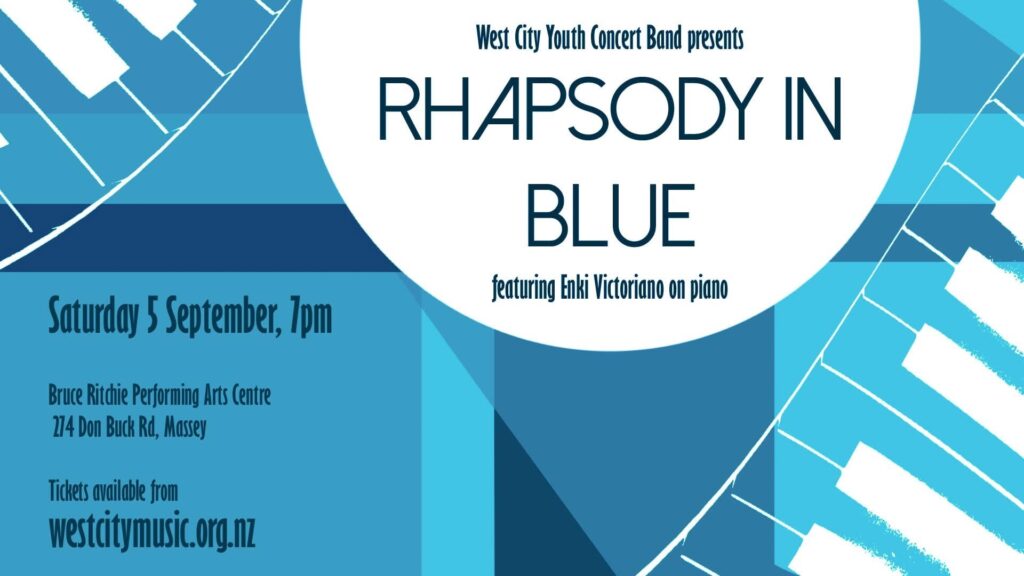
Saturday 5th September
Bruce Ritchie Theatre, Massey High School
7 pm

Purchase Tickets

Join the West City Youth Concert Band in a standalone concert, with featured pianist Enki Victoriano, featuring music by Frank Ticheli, Kelijah Dunton, John Mackey and, of course, “Rhapsody in Blue” by George Gershwin.

Flight of the Thunderbird — Richard L. Saucedo

Richard L. Saucedo’s Flight of the Thunderbird bursts into life with driving percussion before launching into a bold, fanfare-like statement from the winds. The work was commissioned in 2004 by the Mahwah High School Band in New Jersey. When it came time to name the piece, the students chose to honour their school mascot, the Thunderbird. Energetic rhythms, brilliant brass writing and colourful percussion give the music a tremendous sense of momentum, creating the impression of a powerful creature taking flight.

Colorado Peaks — Dana Wilson

Colorado Peaks was inspired by composer Dana Wilson’s experiences of the awe-inspiring Colorado Rockies. Rather than attempting to depict the mountains themselves, Wilson uses the music to explore a person’s relationship with them, particularly the challenge of a rugged and persistent climb. The music is filled with determination, energy and a strong sense of forward motion, capturing both the physical effort of the ascent and the exhilaration of reaching towards something greater. Throughout the work, moments of struggle and reflection are balanced by passages of grandeur, creating a musical journey that celebrates perseverance and adventure.

An American Elegy — Frank Ticheli

Above all, Frank Ticheli’s An American Elegy is an expression of hope. The work was composed in memory of those who lost their lives in the tragedy at Columbine High School on 20 April 1999, and to honour the survivors, their families and their community.

Ticheli described the piece as a tribute to the extraordinary strength and courage shown in the face of tragedy. Through moments of grief, reflection and soaring lyricism, the music gradually moves towards a sense of healing and hope. The composer also intended the work to remind us of the fragility and preciousness of life, and of how deeply connected we are to one another as human beings.

Rhapsody in Blue — George Gershwin

Few works capture the energy and excitement of early twentieth-century America quite like George Gershwin’s Rhapsody in Blue. It was premiered on 12 February 1924 at Aeolian Hall in New York City, with Gershwin himself as the piano soloist. The audience included some of the greatest musical figures of the time, including Sergei Rachmaninoff and John Philip Sousa.

Commissioned by bandleader Paul Whiteman and written in only a few weeks, Rhapsody in Blue was conceived as an experiment in bringing the worlds of jazz and classical music together. Its famous opening clarinet glissando leads into a work filled with jazz rhythms, blues-inspired melodies, sweeping romantic themes and dazzling piano writing.

More than a century after its premiere, Rhapsody in Blue remains one of the most recognisable works in American music and has appeared everywhere from the concert hall to film, television, the Olympic Games and Disney’s Fantasia 2000.

Tonight, we are delighted to feature Enki Victoriano as our piano soloist.

Intermission

Soaring — Naoya Wada

Naoya Wada’s Soaring began life as a short fanfare before the composer expanded it into the concert overture heard today. Its title reflects Wada’s belief that young musicians can use their experiences in music as a foundation from which to “soar” into the future.

That sense of optimism can be heard throughout the work. Bright fanfares, energetic rhythms and broad, uplifting melodies combine to create music filled with excitement and possibility. At its heart, Soaring celebrates growth: the idea that every rehearsal, performance and musical experience becomes part of something larger, helping young musicians develop the confidence and skills to take their next steps.

Bicycle Shoppe — Lisa DeSpain

Lisa DeSpain’s Bicycle Shoppe was commissioned by the United States Air Force Band of Flight to commemorate the centenary of the Wright brothers’ first powered flight.

Before becoming aviation pioneers, Orville and Wilbur Wright owned and operated a bicycle shop in Dayton, Ohio. DeSpain draws inspiration from this earlier chapter of their lives and from the late nineteenth-century fascination with bicycles, movement and speed. The resulting music is playful, mechanical and full of character, with rhythmic figures suggesting spinning wheels, turning gears and the constant activity of a busy workshop.

Behind its humour and energy is a celebration of curiosity and invention, qualities that would eventually take the Wright brothers from their bicycle shop to the skies.

Tears of St. Lawrence — Aaron Perrine

Aaron Perrine’s Tears of St. Lawrence was inspired by a deeply personal evening spent with his five-year-old daughter. Fascinated by astronomy, she had spent months hoping to see a falling star but had repeatedly been disappointed. Then, during the annual Perseid meteor shower, sometimes known as the “Tears of St. Lawrence”, Perrine woke her shortly after midnight and took her outside.

Eventually, they saw their first shooting star together. What followed were two hours of meteors, stories and conversation beneath the night sky.

For Perrine, however, the evening also carried a sense of nostalgia. His daughter was only weeks away from starting school, and the experience became a reminder of how quickly childhood passes. The music reflects this mixture of wonder, excitement, tenderness and reflection, capturing both the beauty of the night sky and the preciousness of a shared moment.

Still Water

Still Water takes its inspiration from the winter landscape of Stillwater, Minnesota. As temperatures fall, the surface of the water freezes, appearing completely still and immovable. Yet beneath that frozen surface, the water continues to flow.

This image becomes a metaphor for our own lives. From the outside, we may appear caught up in the routines and responsibilities of work, school and family. Yet beneath that surface lies something far deeper: our passions, hopes, memories and sense of belonging.

The music invites us to slow down and listen. Like water continuing to move beneath the ice, there is always more happening within us than can be seen from the outside.

Undertow — John Mackey

John Mackey’s Undertow is a concentrated burst of rhythmic energy. From its opening moments, an infectious pulse drives the music relentlessly forward, with constantly shifting metres, including alternating passages of 4/4 and 7/8, keeping both performers and listeners on their toes.

Percussion plays a particularly important role, adding colour, momentum and excitement to the music, while sharp accents and rapidly changing musical ideas create a feeling of being pulled forward by an unstoppable current.

Featured Artist: Enki Victoriano

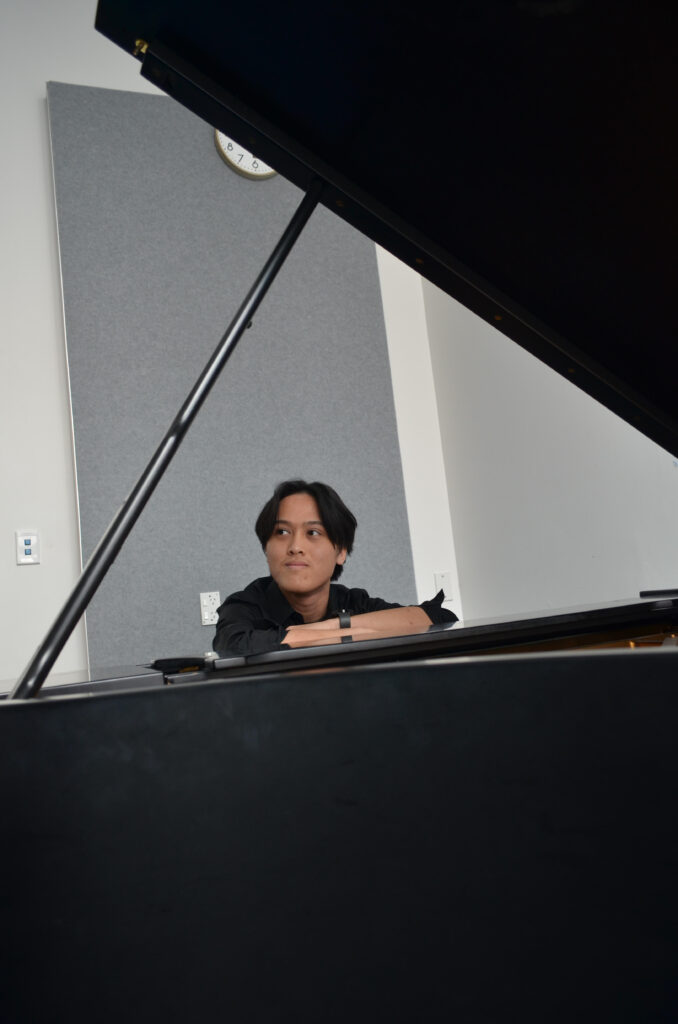
Enki began playing the piano at the age of 10 and is currently a student at the University of Auckland, pursuing a conjoint degree in Statistics and Piano Performance. He currently studies with Camila de Oliveira and previously studied with Oliver Huang-Hsu and Maria La Fernais. Enki has performed in various competition recitals, including the West Auckland performing arts competition and the Singapore International Piano Competition.  

Before his studies at university, Enki was previously involved with high school Jazz and Concert Band competing in various music festivals including the KBB Music Festival, MusicWorks Ensemble Festival Aotearoa and the National Jazz Youth Competition. Enki previously participated in the NZCBA festival with the West City Concert Band as a percussionist. His band achieved a gold award alongside the Robert Lutt Trophy. He also participated as a soloist achieving a gold award for his piano performance.

Enki enjoys expressing himself through music as a soloist, ensemble member and a collaborator.  

Outside of music, Enki enjoys playing video games and spending time with family.

Purchase Tickets